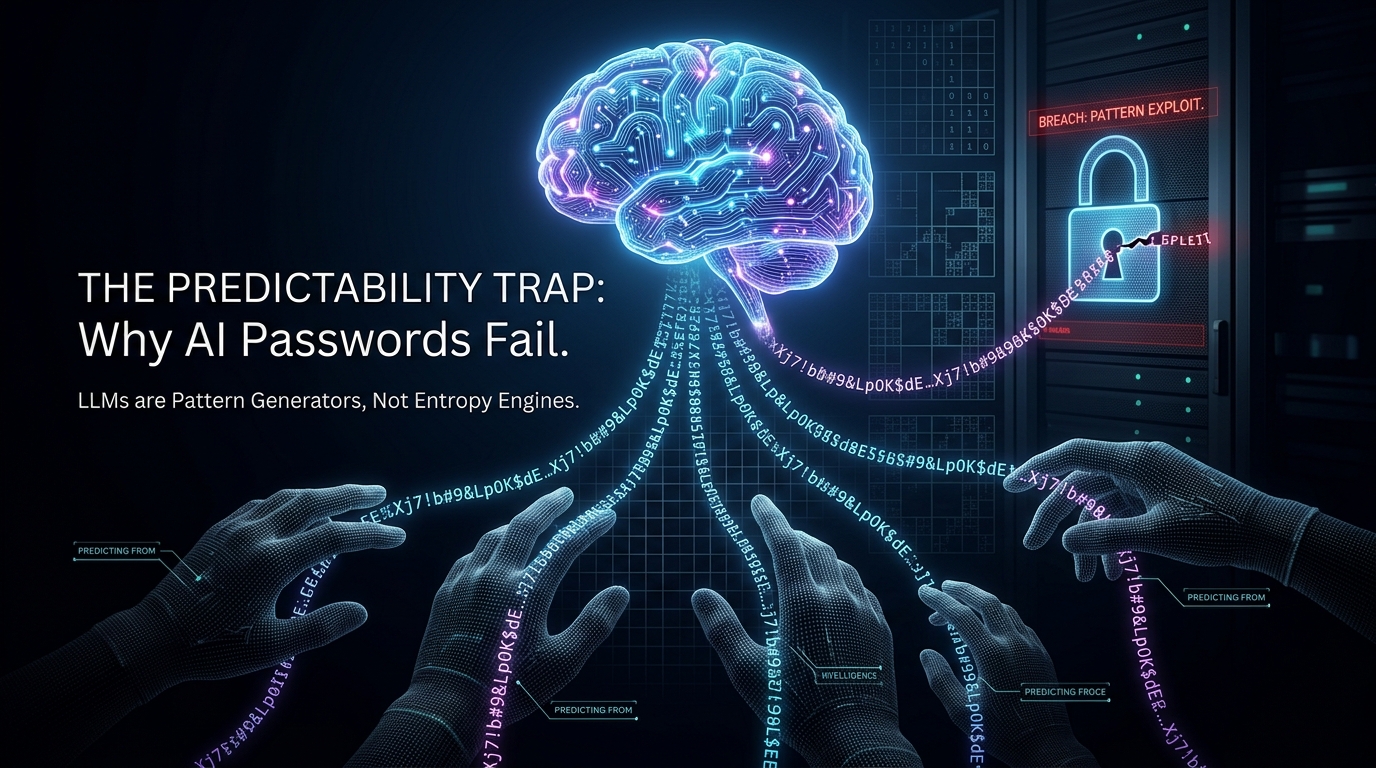
The Predictability Trap: Why AI-Generated Passwords are a New Breach Vector
As engineers, we’ve been trained to value randomness. We know that Password123 is a joke, so we move toward complexity. With the rise of LLMs, many developers have started using them as a quick utility for generating everything from boilerplate code to "secure" credentials.
The logic seems sound: "The AI is smarter than me; surely its 'random' string is better than what I can think of."
The problem is that LLMs are not random. They are statistical engines built to predict the most likely next token based on patterns. When you ask an AI for a "secure password," you aren't getting entropy; you're getting a high-probability pattern that a sophisticated attacker can replicate.
True security relies on high entropy—total unpredictability. A computer's cryptographically secure pseudo-random number generator (CSPRNG) pulls from hardware noise to ensure a string has no pattern.
An AI, however, is trained on human data. When it generates a "random" string, it is biased by its training set. If thousands of developers have used similar prompts, the AI’s "unique" outputs begin to cluster. This creates a new kind of breach vector: prompt-based brute forcing. If an attacker knows which model you used and the prompt you gave it, they’ve narrowed down the search space from trillions of possibilities to a much smaller, predictable subset.
Beyond the generation itself, there is a massive operational risk. When a developer asks an AI for a production secret or a database password, that secret is now part of the conversation history.
It lives in the provider's logs.
It may be used for future training.
It is accessible to anyone with access to that developer's account.
By using an AI to generate secrets, you’ve effectively "leaked" the secret at the moment of its creation. You’ve bypassed the secure, local environment of your machine and sent your most sensitive credentials to a third-party server.
At AmgapTech, we see this often during security audits. We find ""random"-looking strings in .env files that have tell-tale AI patterns—specific lengths, common character distributions, or even recognizable "AI-isms."
We’ve moved to a strict policy: AI is for logic, not for secrets.
The Logic: Use AI to help write the script that calls a secure vault.
The Secret: Use
/dev/urandomdedicated secret management tools (like HashiCorp Vault or AWS Secrets Manager) to generate the actual value.
The hard truth is that using AI for security tasks is a symptom of "convenience-driven development." It’s faster to ask a bot for a string than to remember the syntax for a secure shell command. But in engineering, the easiest path is rarely the most secure.
If your "random" password can be reconstructed by a model with the right prompt, it isn't a password—it's a shared secret between you and the AI.
AI is a tool for productivity, but it was never designed for cryptography. To protect your infrastructure, you need to keep your entropy local and your secrets out of the chat window.
The products that win aren't just the ones that ship fast—they're the ones that stay online because their foundation isn't built on predictable patterns.
Are you generating secrets, or are you just generating patterns? If it’s the latter, the breach has already started.
Sources
Stay updated
Get our latest technical articles and product updates delivered to your inbox.