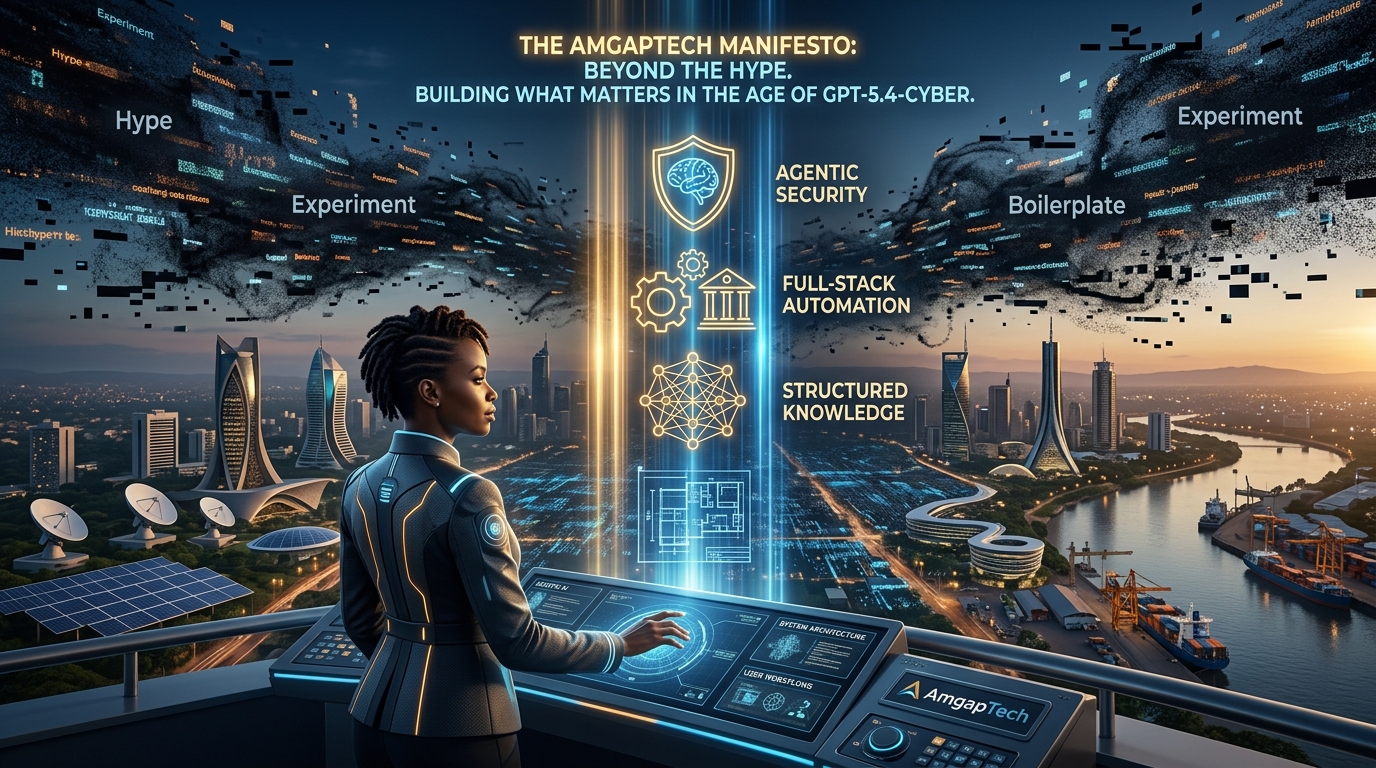
Beyond the Hype: Building What Matters in the Age of GPT-5.4-Cyber
We are currently living through a period of "Innovation Fatigue." Every week, a new model drops that claims to "change everything." Whether it’s OpenAI’s latest GPT-5.4-Cyber or Anthropic’s new full-stack app creation environment, the technical landscape is moving faster than most businesses can keep up with.
But at AmgapTech, we’ve noticed a curious trend: while the models are getting smarter, the products being built with them are often getting shallower. Most "AI innovations" we see are just clever wrappers around an API. They solve for novelty, not for utility. To move forward, we have to stop asking what the AI can do and start asking what our users actually need it to do.
The release of GPT-5.4-Cyber isn't just about a smarter chatbot. It represents a shift toward specialized, agentic security. For the first time, we have models that don't just "spot" vulnerabilities—they can actively patch them in real-time.
In our view, this is the end of the "Patch Tuesday" era. With 5.4-Cyber, security is becoming a continuous, live process. But the catch is that you have to trust the model with your source code. For many, that's a bridge too far. Our role at AmgapTech is to build the "Trust Layer" that allows these models to work within a secure, containerized environment, ensuring that "Cyber" doesn't turn into "Backdoor."
Anthropic’s push into full-stack app creation is perhaps the most disruptive change for the developer community. We are moving toward a world where the "middle-tier" developer tasks—writing migrations, setting up CRUD routes, and styling basic UI—are becoming 100% automated.
This isn't a threat; it’s a liberation. If the AI can handle the 80% of software that is "boilerplate," it frees us to focus on the 20% that is actually hard: the business logic, the user empathy, and the complex system architecture. We are moving from being "coders" to being "product architects."
Here is the honest trade-off we see every day: Shipping an AI feature is easy; shipping an AI product is incredibly hard. The technical hurdles—latency, cost, and hallucination—are real. But the biggest hurdle is Integration. You can have the most advanced model in the world, but if it isn't deeply integrated into your user's existing workflow, they won't use it.
The "hard truth" is that the best AI is often invisible. It’s the background process that optimizes a data pipeline or the agent that cancels a subscription without the user ever clicking a button. If the user has to "work" to use your AI, you've already lost.
We don't build "AI for the sake of AI." We build solutions that use these innovations to solve the specific, messy problems of digital transformation, especially in the African landscape where efficiency isn't just a goal—it's a necessity.
Whether it's securing a government digital backbone or automating a car brokerage showroom, our perspective is simple: High-tech must yield high-impact. We use the new wave of innovations as a fuel, not as a destination.
The era of the "AI Experiment" is officially over. The products that win in 2026 won't be the ones that talk about GPT-5.4 the most. They will be the ones that use it to make the user’s life 10x easier.
At AmgapTech, we are navigating the noise to bring you the signal. We are building the "Action Layer" for the modern world.
Is your technology solving a problem, or is it just part of the noise?
Sources
Stay updated
Get our latest technical articles and product updates delivered to your inbox.